Cemented carbide is extensively applied in the production of heavy equipment components and wear parts. When dealing with carbide components that feature complex structures or special geometries, buyers often face a choice. Some prefer to purchase carbide preforms, also known as near-net shape carbide parts, and complete the final machining in-house. Others choose finished tungsten carbide parts that are ready for direct use.
So, what is the difference between carbide preforms and finished carbide parts? More importantly, as a buyer, which one should you choose? Let's discuss these questions now.
Similarities Between Carbide Preforms and Finished Carbide Parts
1. Material
Both carbide preforms and finished carbide parts are made from cemented carbide .
2. Appearance
Carbide preforms and finished carbide components are largely similar in shape as well as overall geometry.
3. Purpose
Whether a carbide wear part is produced through a preform route or supplied as a finished part, the component that eventually works in the equipment must meet the same design function, operating conditions, and reliability standards.
Differences Between Carbide Preforms and Finished Carbide Parts
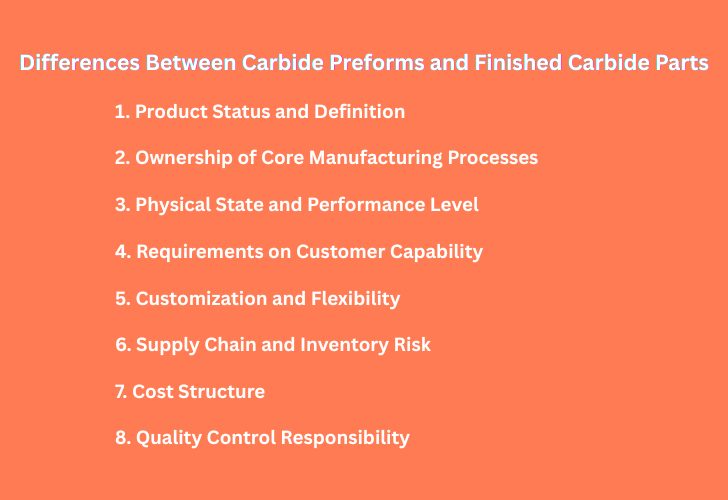
1. Product Status and Definition
Carbide preforms are near-net shape green bodies. They are unsintered intermediate products whose geometry is already close to the final design. At this stage, they are not ready for use.
Finished carbide parts, on the other hand, are ready-to-use components. All manufacturing steps, including sintering, precision grinding, and coating if required, have already been completed. They are ready for use.
2. Ownership of Core Manufacturing Processes
With carbide preforms, the supplier mainly provides the forming foundation. Critical processes such as sintering, final grinding, and coating are carried out by the customer. The performance outcome depends largely on the customer's process control.
For finished carbide components, all core processes are completed by the supplier. The customer does not need to intervene in material processing.
3. Physical State and Performance Level
Carbide preforms are in a green state. They have low hardness and strength, are porous, and easy to damage. Their mechanical properties, density, and dimensional accuracy are not yet established and must be achieved through subsequent sintering.
Finished tungsten carbide parts are fully dense. They already possess final hardness, wear resistance, and structural strength. Their performance is fixed and cannot be altered without remanufacturing.
4. Requirements on Customer Capability
Using carbide preforms places very high demands on the customer. The customer must have reliable sintering capability to control temperature profiles and atmospheres, precision grinding equipment with diamond wheels, and possibly coating capacity.
Finished carbide wear parts require minimal capability from the customer. Only proper installation and use are needed. No material or process expertise is required.
5. Customization and Flexibility
Carbide preforms offer extremely high flexibility. Customers can fine-tune final properties through sintering parameters, control dimensions and tolerances through grinding, and select coatings independently. This route suits small batches, multiple variants, and high-performance customization.
Finished carbide parts offer limited flexibility. All characteristics are fixed at delivery. Any change requires reordering customized parts from the supplier, usually with a longer lead time. This option fits standardized and high-volume demand.
6. Supply Chain and Inventory Risk
Carbide preforms usually have a shorter purchasing lead time because pressing green bodies is relatively fast. However, the customer's total manufacturing cycle is longer due to follow-up processes. Inventory consists of semi-finished, more generic items, so the risk is lower.
Finished carbide components have a longer purchasing lead time because the full production cycle is included. Inventory consists of specific finished parts, which increases SKU complexity, capital occupation, and inventory risk.
7. Cost Structure
Carbide preforms have a lower initial purchase cost. However, customers must bear the hidden costs of equipment depreciation, energy consumption, labor, process development, and yield loss. The total cost depends heavily on internal efficiency.
Finished tungsten carbide wear parts have a higher unit price. The price includes all processing costs and risks borne by the supplier. For the customer, the total cost of ownership is clear and predictable.
8. Quality Control Responsibility
For carbide preforms, quality responsibility is shared. The supplier is responsible for forming density and uniformity, while the customer is responsible for achieving final performance. The responsibility on the customer side is significant.
For finished carbide parts, quality responsibility lies almost entirely with the supplier. The customer only needs to inspect against drawings and specifications, making accountability clear.
Which One Should You Choose?
It depends. Choosing between carbide preforms and finished carbide wear parts is not about which one is better, but which one fits your role, capability, and business model better.
Choosing Finished Carbide Parts
When the customer is primarily a user, not a manufacturer, finished parts should be the choice. Typical examples include mining equipment manufacturers, pump and valve producers, and machinery assembly companies. Their core business is assembling systems and selling complete equipment, not developing carbide processing capability. For these companies, investing time and resources in sintering, precision grinding, and coating does not create additional value.
When the demand is standardized and volumes are relatively large, finished parts are more suitable. By sourcing finished parts, customers benefit from the supplier's specialization, process maturity, and economies of scale. The result is stable quality, predictable performance, and simplified supply chain management.
In addition, carbide sintering and fine grinding are highly specialized processes. For customers without existing technical know-how and equipment, building such capabilities requires high investment and carries significant risk. In this case, purchasing ready-to-use carbide parts is clearly the more time-saving and efficient solution.
Choosing Carbide Preforms
Carbide preforms become the better option when the customer is already a professional manufacturer of tools or wear parts. Leading cutting tool brands and specialized tungsten carbide wear part manufacturers usually have their own sintering furnaces, precision grinding machines, and coating facilities. For them, near-net shape carbide preforms help streamline production rather than complicate it.
- From a time perspective, carbide preforms eliminate the powder pressing stage. This shortens the internal production cycle and allows manufacturers to respond faster to urgent or small-batch orders.
- From an efficiency perspective, these customers keep the highest value-added processes in-house. This maximizes profit margins and enables deeper customization. Performance tuning, dimensional control, and coating selection can all be optimized according to their own standards.
Carbide preforms are also preferred when customers have proprietary processes or performance requirements. Unique sintering profiles, post-treatment methods, or coating technologies are often core competitive assets. Using preforms allows manufacturers to protect this know-how without relying on external suppliers for finished carbide components.
Conclusion
In simple terms, carbide preforms are like pre-seasoned, pre-cut ingredients prepared for professional chefs. Finished carbide components, on the other hand, are more like fully cooked, ready-to-use meals. Neither option is universally better. Carbide preforms suit manufacturers who want control and customization. Finished carbide wear parts suit users who value simplicity, reliability, and efficiency. The right choice depends on who you are in the supply chain and what you want to control.