Circular saw blade tooth geometry plays a crucial role in determining cutting speed, surface finish, and overall efficiency. Different tooth shapes are designed for different cutting purposes, and each configuration performs best under specific conditions. Today, we will walk you through the most widely used tooth shapes and their typical applications, helping you find the right option for your woodworking needs.
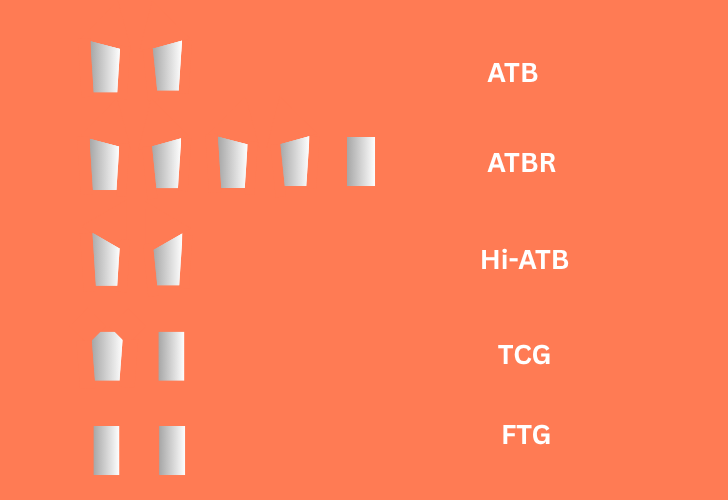
1. ATB (Alternate Top Bevel)
The ATB tooth grind is definitely the most familiar type you will see in woodworking. It features teeth with alternately beveled tops, meaning one tooth is angled to the left while the next one is angled to the right, forming a pair. This alternating design creates a sharp cutting point and improves cutting performance.
An ATB grind saw blade is widely regarded as a versatile option. However, it truly stands out in crosscutting applications. It is especially suitable for cutting solid wood and veneered plywood, where a clean surface finish is required.
2. ATBR (Alternate Top Bevel with Raker)
Compared with ATB, the ATBR tooth grind is a more versatile option in circular saw blade teeth. It is commonly seen on combination blades used in woodworking. An ATBR grind saw blade features a repeating group of five teeth: four ATB teeth followed by one flat-top tooth, also known as a raker. The raker tooth has a flat top and usually sits slightly lower than the preceding ATB teeth. The ATB teeth handle clean cutting, while the raker tooth helps stabilize the cutting process and remove chips. If you prefer not to switch blades frequently, an ATBR grind saw blade is your choice.
3. Hi-ATB (High Alternate Top Bevel)
The Hi-ATB tooth grind can be regarded as an upgraded version of the standard ATB design in circular saw blade applications. The main difference lies in the bevel angle. While a regular ATB tooth usually features a bevel angle of around 10° to 20°, a Hi-ATB tooth grind increases this angle to approximately 25° to 30°, creating a much sharper cutting point.
Hi-ATB is ideal for applications that require a very fine finish in woodworking. It is especially suitable for cutting veneered plywood, laminates, and similar materials.
4. TCG (Triple Chip Grind)
The TCG tooth grind features a completely different structure. It consists of a repeating pair of teeth: one trapezoidal tooth followed by one flat-top tooth. The trapezoidal tooth cuts into the material first, creating a groove, while the flat tooth follows to remove chips and widen the groove.
The TCG tooth grind is ideal for cutting harder materials. It performs well on MDF, laminates, and chipboard, and can also be used for plastics and non-ferrous metals.
5. FTG (Flat Top Grind)
The FTG tooth grind is one of the simplest types in circular saw blade designs. As the name suggests, the top of each tooth is completely flat, without any bevel.
Circular saw blades with FTG teeth are mainly used for ripping in woodworking. It removes material quickly and efficiently. So, it's best for projects where cutting speed is more important than surface finish.
Conclusion
As you can see, different circular saw blade tooth geometries are designed for various cutting purposes. There is no "one-size-fits-all" option, and each tooth grind has its own strengths in woodworking applications . Therefore, when selecting a blade, it is always important to match the tooth type with your material and cutting needs.