Although small in size, router bits play a crucial role in determining the final quality of a woodworking project as well as the overall machining cost. Today, we will take a closer look at router bits. The purpose of our article is to help you make more cost-effective decisions for your woodworking projects.
What is a Router Bit?
A router bit is a cutting tool mounted on a handheld router or a CNC router machine. The bit is held tightly by a collet and fixed on the machine. When the router starts running, the collet rotates at high speed, driving the router bit to cut the material.
Router bits come with many different cutting profiles. Each design serves a specific woodworking purpose, such as cutting grooves, shaping edges, or creating decorative profiles.
Main Parts of a Router Bit
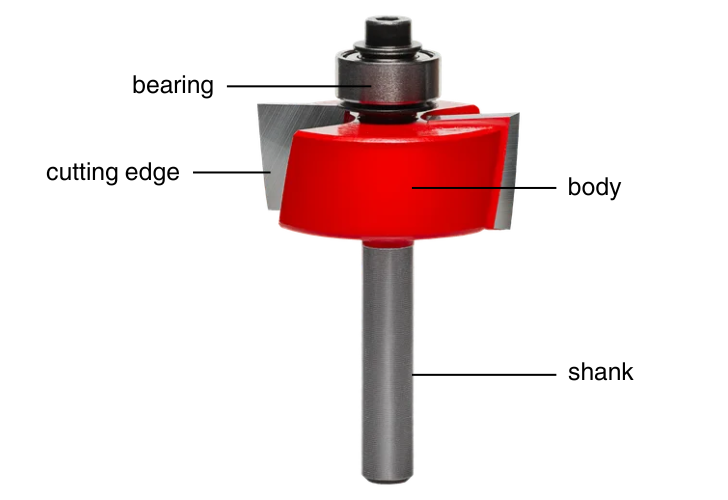
In general, a router bit consists of several basic parts, including the shank, body, cutting edges, and bearing.
(Image Source: diablotools.com)
Shank
The shank is the part that is inserted into the router collet and fixed on the machine. The two mainstream shank sizes are 1/2 inch and 1/4 inch. A 1/2-inch shank offers better stability during operation. Therefore, it is especially common in CNC routing where stability and strength are important. In comparison, a 1/4-inch shank is more suitable for lighter routing tasks, such as installing on handheld routers for detailed or light-duty woodworking.
Body
The body is the main steel structure of the router bit. It connects the shank and the cutting edges. The body provides the necessary strength and support so that the bit can rotate smoothly and maintain stability during cutting.
Cutting Edges
The cutting edges, also called cutters or blades, are the parts that actually remove material. When the router rotates at high speed, these cutting edges contact the workpiece and perform the cutting work. In most router bits, the cutting edges are made from carbide and brazed onto the steel body of the bit. Compared with HSS, carbide offers much better wear resistance and a longer service life.
Bearing
Some router bits are equipped with a pilot bearing. The bearing helps guide the bit along the edge of the workpiece or along a template. This allows the router bit to follow a consistent path and produce more accurate results.
Router Bit Types
One of the biggest features of router bits is the wide variety. This also makes selection a bit challenging, especially for beginners. Today, we won't go too deep into every type. Instead, we will go through the main categories of router bits from a more general perspective.
1. Straight Router Bits
(Image Source: freudtools.com)
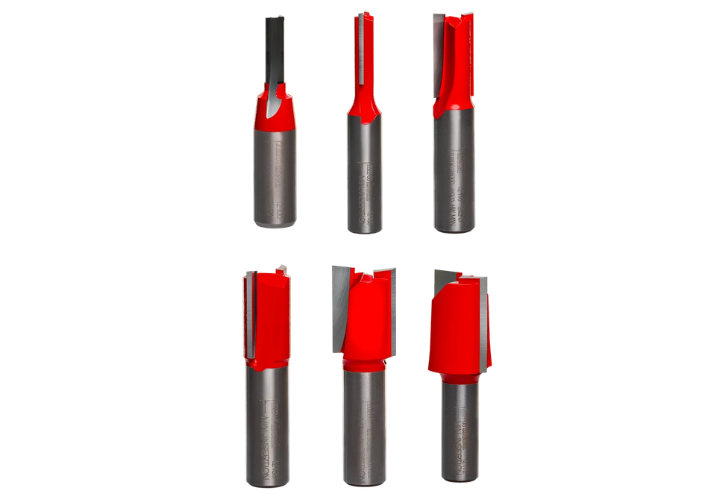
Straight router bits are definitely the first type you will come across. No matter what kind of woodworking project you are working on, this bit is almost always required. A straight router bit cuts directly into the surface of the material. It is mainly used for making grooves, dadoes, and rabbets, or hollowing out areas for joinery. Thanks to its straight cutting edges and flat bottom design, it can produce clean and accurate cuts.
Straight router bits include several common sub-types, such as double-flute straight router bits, mortising router bits, and bottom cleaning router bits. Each type is designed for a specific task, but all of them are built on the same basic cutting principle.
2. Flush Trim Router Bits
(Image Source: left-diablotools.com; right-freudtools.com)
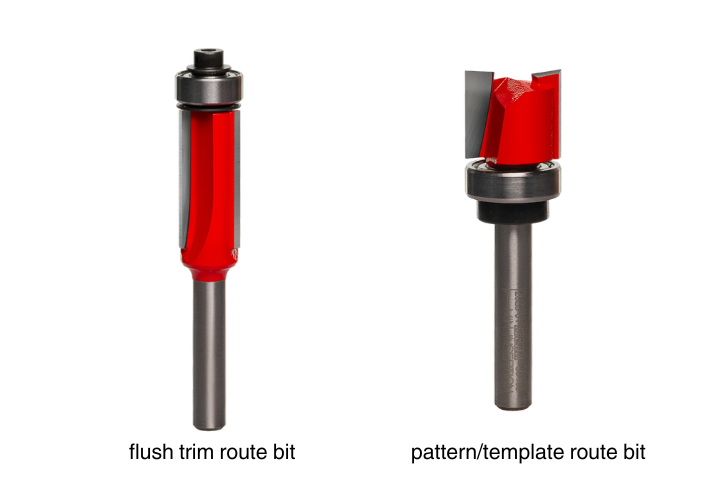
At first glance, flush trim router bits look very similar to straight bits. However, the key difference lies in the pilot bearing mounted at the tip of the bit. During operation, the bearing rides along a template or the edge of another surface, while the cutting edges remove the excess material. In this way, the router bit can trim the workpiece edge perfectly flush or duplicate the exact shape of a template. This makes flush trim bits a must-have for trimming laminates, veneers, and pattern work.
It is also important not to confuse flush trim bits with pattern bits (template bits). The difference is the position of the bearing. A flush trim bit has the bearing at the tip of the bit, while a pattern bit places the bearing near the shank, between the shank and the cutting edges. Because of this, their applications and setups are not exactly the same, even though both are used for template-guided cutting.
3. Door and Window Router Bits
(Image Source: freudtools.com)
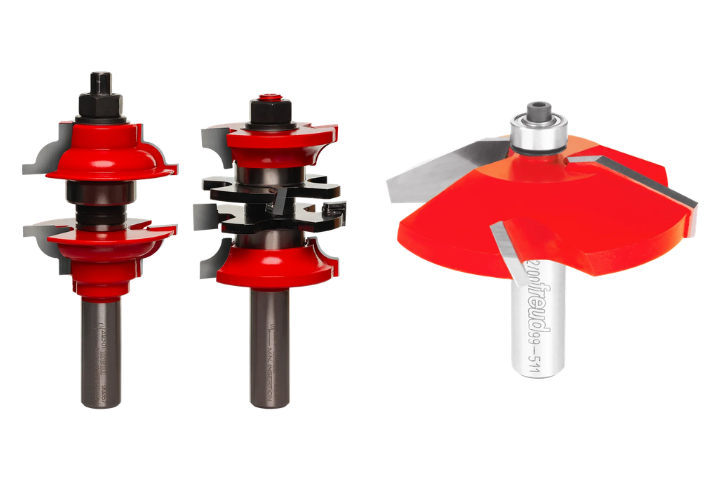
As the name suggests, door and window router bits are mainly used in the manufacturing of doors, windows, and cabinets. These bits are essential for making structured components and decorative profiles in furniture production. One of the most common applications is producing rail and stile joints, which are widely used in cabinet doors. In addition, these router bits are also used for shaping the edges of raised panels, creating decorative profiles while reducing the panel thickness so that it can fit into the frame properly.
This category mainly includes stile & rail router bits, raised panel router bits, and finger pull router bits, etc.
4. Edge-Forming Router Bits
(Image Source: freudtools.com)
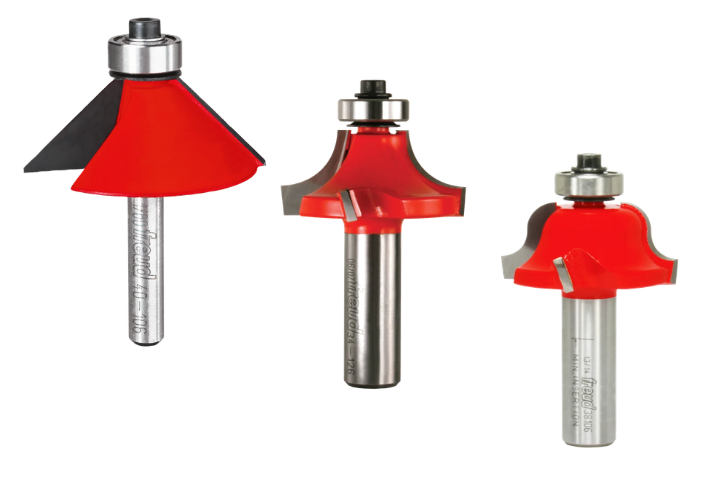
Compared with other categories, edge-forming router bits cover a very wide range of types. The main purpose of edge-forming router bits is to create clean and decorative edge profiles. At the same time, they can also improve functionality by removing sharp edges and making the surface safer and more comfortable to touch.
They are widely used in woodworking projects such as tabletops, picture frames, shelves, cabinets, and more. Whenever edge shaping is required, there is always a suitable edge-forming router bit for the job. Common types include chamfer router bits, roundover router bits, beading router bits, and Roman ogee router bits, etc.
5. Joinery Router Bits
(Image Source: freudtools.com)
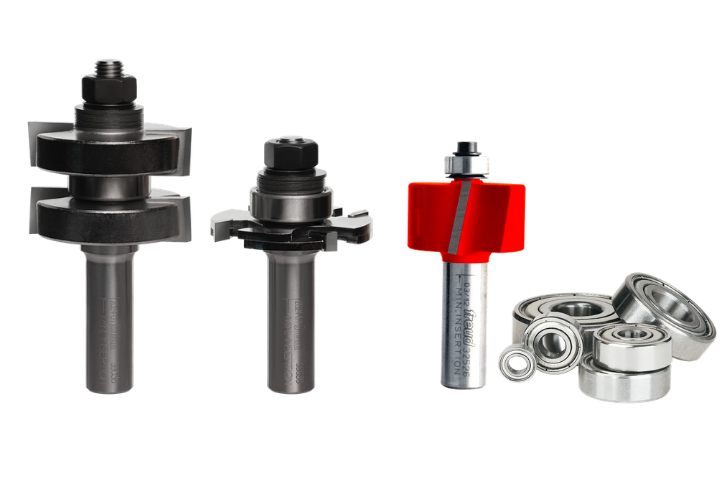
Joinery router bits are used to create joints between workpieces. Whether it is a rabbet joint or a tongue and groove joint, these bits can handle the job.
Joinery router bits are widely used in furniture and cabinet making because they help create tight and reliable connections between wood pieces. Common types include rabbeting router bits and tongue and groove router bits. Each type is designed for a specific joint profile. For example, rabbeting bits are used to cut shoulders along the edge, while tongue and groove bits create matching profiles for easy assembly.
6. Solid Carbide Spiral Router Bits
(Image Source: freudtools.com)
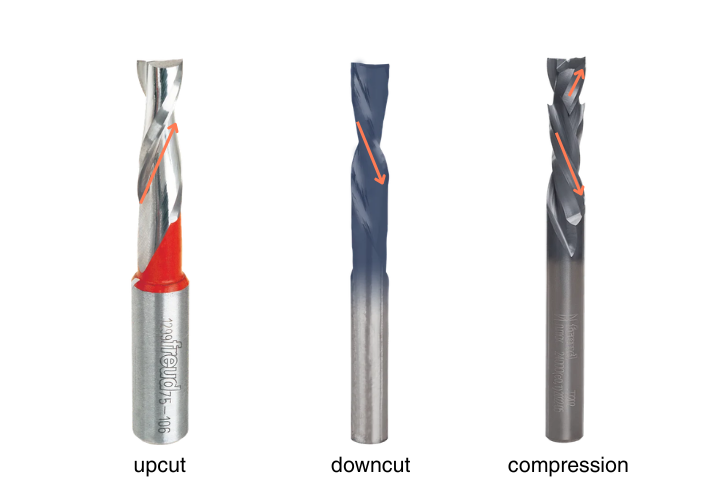
Solid carbide spiral router bits are quite different from standard router bits. They are made entirely from solid carbide, including the shank, instead of a steel body with carbide tips. Another key feature is the spiral cutting edge rather than a straight one. This design provides a smoother cutting finish and better chip evacuation, which makes these bits more suitable for high-speed and CNC machining.
Based on the cutting direction, they can be divided into upcut, downcut, and compression types. Upcut bits produce a clean surface on the top, while downcut bits improve the finish on the bottom. Compression bits combine both advantages. Common types include O flute router bits, two/double flute spiral router bits, three flute spiral router bits, and compression spiral router bits.
How to Choose the Right Router Bit Supplier?
As a buyer, you are not just choosing a product, but a long-term partner. Whether you are a furniture factory, a trader, or a small woodworking shop, the logic of selecting suppliers is slightly different. Let's break it down in a simple way.
1. For furniture manufacturers, the goal is not to buy the cheapest bits, but the ones that help you save money and make money. What really matters is not the unit price, but the cost per piece: how long the bit lasts and how well it performs.

(Image Source: Photo by William Kedersha from Pixabay.com)
When evaluating suppliers, quality should come first, taking the biggest weight. Focus on cutting performance and tool life. Price should be judged based on overall cost per piece, not the purchase price. Service also matters, such as delivery stability and response speed.
The most reliable way is testing. Buy the same type of bits from different suppliers, remove the packaging, label them, and run blind tests. Use the same material and parameters, then compare surface finish, performance after continuous use, and total lifespan. In the end, calculate the cost per piece. You will often find that a bit that costs more upfront can actually save more in the long run.
2. For traders, the focus is on margin and turnover. Purchase price plays a key role, but quality cannot be ignored. Otherwise, customer complaints will follow.
In this case, price has the highest priority. At the same time, quality must be stable and acceptable. Delivery capability is also critical because stockouts directly affect your business.
To avoid risks, first figure out whether the supplier is a real manufacturer or just a middleman. Ask about production processes or request workshop videos. Second, check their customer base. Suppliers with experience in higher-end markets are usually more reliable. Third, start with small trial orders. Test delivery, packaging, and customer feedback before scaling up.
3. For small workshops or individual woodworkers, you are both the buyer and the user. Your decision sits somewhere between factories and traders.

(Image Source: Photo by Craft Kitties on Unsplash.com)
You don't always need the cheapest option, and you may not need the top brands either. The key is finding the right balance between performance and price.
The simplest way is to test by yourself. After using the bits, you will know how smooth the finish is, whether the cutting is stable, and how well it handles different materials. In addition, pay attention to supplier support, such as regrinding services and technical assistance. These details often matter more than specs on paper.
Conclusion
Router bits play an essential role in woodworking. That's why choosing the right bit and the right supplier requires careful comparison and real testing. We hope this guide helps you better understand router bits and make more informed decisions. If you are looking for reliable woodworking router bit suppliers, feel free to explore our supplier list .